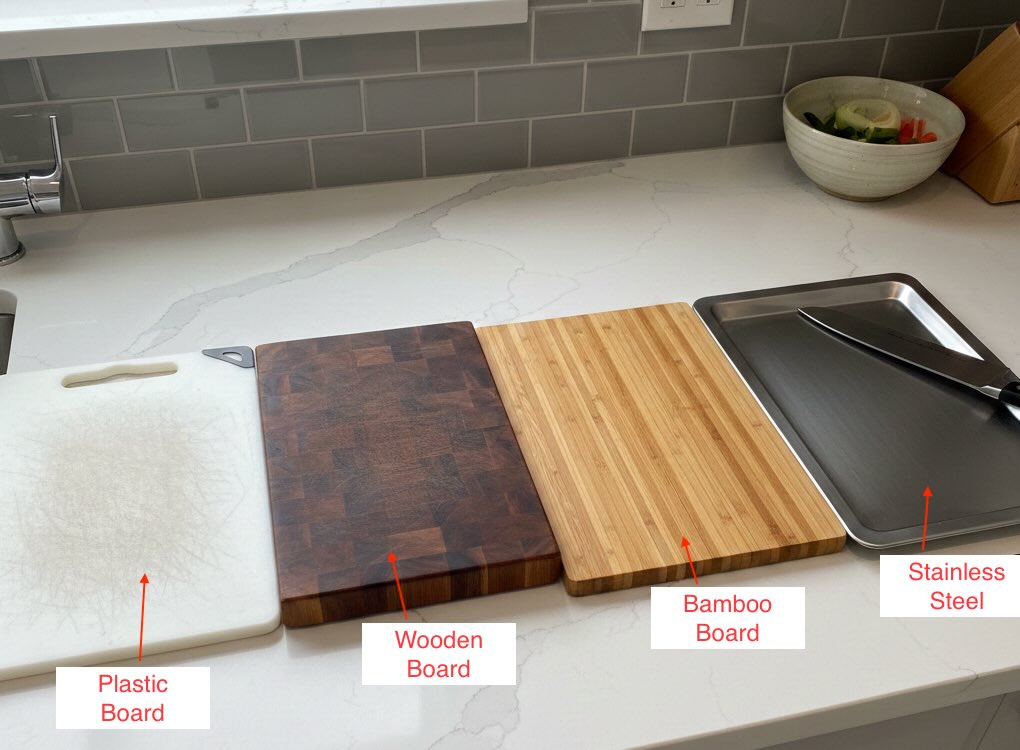
These are my results…
There was a post on a Reddit discussion where people were talking about microplastics coming from everyday kitchen items, including cutting boards, and whether switching materials actually reduces exposure.
It got me thinking…
I cook most days, and like a lot of people, I’ve used plastic cutting boards for years without thinking about what happens to them over time. Seeing people discuss knife scratches turning into microplastic particles made me stop and really look at what was happening on my own countertop.
The Question I Wanted to Answer
The conversation that caught my attention centered on a simple observation: plastic cutting boards get scarred, cloudy, and rough with use, and those grooves don’t just disappear. They’re material that’s been removed. The implication is obvious—some of that removed material becomes tiny plastic particles that can end up in food or on surfaces.
That led me to a practical question: If plastic boards shed microplastics through normal cutting, how much might I actually be generating at home? And would switching materials meaningfully reduce that exposure?
I wasn’t interested in theoretical debates. I wanted to understand what happens in a real kitchen, under normal cooking conditions, with normal knives and food prep.
My Testing Methodology (What I looked into)
I started by examining my own cutting boards. I had four: a white plastic/polyethylene board (I’d use for meats), a bamboo board, wooden cutting board (both used for veggies/fruits), and a stainless steel prep plate/pan (which I used for cutting and prep of things I’d use in the oven or high heat cooking like steaks). All of them showed varying visible wear from fine grooves, knife marks, to slightly chalky look in heavily used areas.

So, I ran a simple observation test over two weeks. I used my plastic board daily for chopping onions, carrots, and chicken, then rinsed it in the sink and wiped it dry with a paper towel. After drying, I checked the towel under bright light. Tiny white specks were visible, especially after heavier chopping sessions. I can’t confirm those were all plastic, but given the color and the board’s wear pattern, it was a reasonable proxy observation.
Next, I compared that with a hardwood, bamboo and steel cutting boards. Same foods, same knife, similar prep time. After washing and wiping, I saw almost no visible residue on the towel beyond normal food particles from the steel and bamboo boards. But the wooden cutting board had more of the visible residue. The bamboo and wood cutting boards developed faint knife marks, but there wasn’t the same powdery residue.
I also looked at what causes cutting board wear in the first place. Three factors stood out:
- Friction from chopping and slicing
- Pressure from heavy cuts
- Cleaning and scrubbing
Plastic boards are softer than steel knives, so each cut removes a small amount of material. Over hundreds or thousands of cuts, that removal becomes visible grooves. Scientific studies on microplastic generation from household plastics confirm that mechanical abrasion is a major pathway for microplastic formation, not just heat or UV exposure. So that’s why it’s kind of obvious the loser here will most likely be the plastic board.
Because I couldn’t directly measure microplastics at home, I looked for proxy indicators:
- Surface degradation over time
- Visible residue during cleaning
- Changes in board texture
- Knife mark depth and density
I also compared how different materials behaved:
- Plastic boards: visibly scratched quickly; surface became matte and rough
- Wood boards: knife marks present but less chalky wear
- Bamboo board: harder surface, slower visible wear
- Stainless prep plate: no visible wear but harder on knives
One more thing I tested was timing. I used a newer plastic board alongside an older one. After two weeks, the older board produced noticeably more visible residue when wiped. That suggested wear accelerates shedding.
Here’s a simple chart summarizing what seemed to increase or reduce shedding of plastic boards from my 2 weeks of testing it:
| Factor That Affects Wear | What Happens to Plastic Boards | Why It Matters for Microplastics |
|---|---|---|
| Heavy chopping (carrots, squash, dense foods) | Increases visible surface wear and deeper grooves | More friction means more plastic material is shaved off over time |
| Serrated knives | Creates aggressive surface abrasion | Jagged edges scrape and tear plastic rather than slice cleanly |
| Scrubbing with abrasive pads | Increases surface roughness and micro-scratches | Cleaning itself can accelerate breakdown of the board |
| Light slicing (soft foods only) | Slower, more gradual wear | Less pressure results in less material removal |
| Hand washing with soft sponge | Reduces new scratches during cleaning | Gentle cleaning helps preserve surface integrity |
| Replacing heavily worn boards | Reduces visible residue and shedding | Older boards shed more due to accumulated surface damage |
The Results & What I Learned
So what were the results from my test? This table below is basically me taking what I actually saw in my kitchen (not in a lab) and ranking each board based on how fast it scratched up, how much residue it left behind, and how sketchy it started looking over time.
Scale explanation:
1 = Minimal observable wear
2 = Slow wear, limited visible change
3 = Noticeable wear over time
4 = Rapid wear and visible material loss
1 = Best (Lowest Risk of Shedding)
4 = Worst (Highest Risk of Shedding)
| Rank | Material | Friction Wear | Pressure Wear | Cleaning Wear | Visible Residue | Surface Degradation | Knife Mark Density | Overall Shedding Risk | Confidence Level |
|---|---|---|---|---|---|---|---|---|---|
| 1 (Winner) | Stainless Steel | 1 | 1 | 1 | 1 | 1 | 1 | Very Low | High |
| 2 | Bamboo | 2 | 2 | 2 | 2 | 2 | 2 | Low | Moderate |
| 3 | Hardwood (Maple) | 3 | 3 | 3 | 3 | 3 | 3 | Moderate | Moderate |
| 4 | Plastic (HDPE/PP) | 4 | 4 | 4 | 4 | 4 | 4 | High | High |
The biggest takeaway was straightforward: plastic cutting boards do wear down in normal use, and that wear means particles are being removed. That’s not speculation—you can see the material disappearing over time.
Whether every particle becomes airborne microplastic or ends up in food depends on many variables, but the physical shedding itself is observable.
I also learned that age matters. Older boards shed more visibly than newer ones. Deep grooves trap food and require more scrubbing, which accelerates degradation.
Switching to wood didn’t eliminate wear entirely, but the behavior was different. The surface didn’t produce the same powdery residue, and the texture aged more gradually. Bamboo behaved somewhere in between. It was harder than wood, but still not producing the chalky wear pattern I saw with plastic.
Another realization was about scale. A single board doesn’t seem like much, but cutting boards are used daily, often multiple times per day, across millions of kitchens. Even small amounts of shedding per use add up over time.
From this I also changed how I handle boards now. I replaced heavily scarred plastic boards, use bamboo and wood for most produce prep, and keep one plastic board only for occasional raw meat prep (but making sure I will replace it more frequently), along with the steel prep board/mat I have (which I want to use more for meat cutting).
What I’d Do If I Were You
If this is something you’re thinking about, here’s what I would actually do in practical terms:
- Look closely at your cutting boards under bright light. Deep grooves and chalky surfaces are signs of heavy wear.
- Replace plastic boards that are heavily scarred rather than continuing to use them indefinitely.
- Use wood or bamboo boards for most daily chopping to reduce plastic abrasion.
- Avoid abrasive scrubbers on plastic boards; they accelerate surface breakdown.
- Keep knives sharp. Dull knives require more pressure and increase material removal.
- Rotate boards instead of using one board exclusively every day.
- Consider separating boards by use so high‑impact chopping doesn’t happen on the same surface constantly.
If you’ve switched cutting board materials, I’m interested to know what differences have you noticed in wear or cleaning? And what other observational (kitchen/table-top/at-home) testing do you think I should have done to improve my ranking?
Here are some of the sources I used to research some background info for this post:
https://www.reddit.com/r/whatisit/comments/1py7n7g/stainless_steel_cutting_boards/ (my inspiration for the test)
https://www.sciencedirect.com/science/article/pii/S2666911021000207
https://www.nature.com/articles/s43017-021-00189-w
https://www.epa.gov/trash-free-waters/microplastics
https://pubs.acs.org/doi/10.1021/acs.est.9b03523


Leave a Reply