After 5 Days Here’s What Came Off…
A few months ago my baby niece had a skin breakout. Nothing dramatic. But enough that her parents changed detergents and eventually bought a separate washer just for baby clothes.
That came back to me when I saw this Reddit post about polyester in baby products and microplastics concerns:
Because I’ve watched washcloths and burp cloths get wiped across my nephew and niece’s face multiple times a day (over the span of months) I can see the constant use it has for newborns. From spit-up, drool to milk residue that means constant laundering.
And I realized I’d never actually looked at what comes off them during those washes. Not necessarily microplastics or PFAS. Just understanding what physically leaves these fabrics.
I decided to do what I always do. An at home test. I tested three baby cloths that my niece and nephew have actually used, plus a polyester one I picked up at Dollar Store as a material control.

The 4 Baby Cloths I Tested
- Lalo – 100% Organic Turkish Cotton Washcloth
- Kushies – 100% Cotton Everyday Layette Bib (Made in Canada)
- Loulou Lollipop – 70% Bamboo Rayon / 30% Cotton Burp Cloth
- Generic 100% Polyester Baby Washcloth from the Dollar Store (control)
| Brand | Product | Material | Country It’s Manufactured In* | Safety / Testing Claims |
|---|---|---|---|---|
| Lalo | The Washcloth | 100% Organic Turkish Cotton | Turkey / China | Organic cotton; non-toxic manufacturing claimed; some lines OEKO-TEX certified |
| Kushies | Everyday Layette Bib | 100% Cotton | Canada | Longstanding Canadian brand; no explicit PFAS or lab testing disclosure |
| Loulou Lollipop | Burp Cloth Set | 70% Bamboo Rayon / 30% Cotton | China / Vietnam | OEKO-TEX certified textiles; ASTM / CPSIA compliant; non-toxic positioning |
The table above is a breakdown of the 3 main brands I tested against the control. I got the information above from the brand website and from lots of internet sleuthing. For example when it came down to where the product is manufactured in these are the assumptions I made:
- Lalo FAQ mentions the bathroom collection products (including the washcloth) are made across Turkey and China.
- On their site, Kushies mentions they have their own production facility in Stoney Creek, Southern Ontario.
- And in a BC Small Business article, Loulou talks about production of their products moving from China to Vietnam.
The polyester cloth wasn’t a brand comparison. It was there to see whether synthetic fiber shedding looks visibly different from natural fiber shedding.
What I Was Testing
What I was observing was physical fiber release — loose surface fibers, cut ends from weaving, mechanical abrasion residue, finishing debris. New textiles almost always release some of this. The question is how much, and how quickly it stabilizes.
This test measured:
- Visible fiber shedding captured during washing
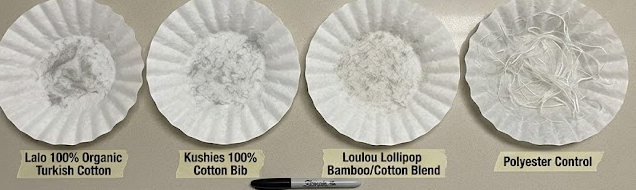
- Fiber counts per wash cycle (counted from dried coffee filters)
- Changes over 5 wash cycles
- Edge wear
- Softness changes
It did NOT measure:
- PFAS
- Antimicrobial coatings
- Chemical residues
- Whether shed fibers are technically microplastics
- Toxicity
That would require lab analysis.
Why This Matters for Polyester Specifically
Before getting into results, it’s worth explaining why polyester shedding is a different conversation than cotton shedding.
Cotton fibers are natural cellulose. When they shed, they break down over time. Polyester fibers are synthetic polymers (ie. petroleum-derived plastic). When they shed, they can become microplastics: particles small enough to pass through water filtration systems and into soil, water, and potentially the body.
Research has found polyester microfibers in human tissue, including the lungs and placenta. The exposure mechanism isn’t fully understood yet, and at-home visual testing can’t confirm whether shed fibers are microplastics (that requires actual lab analysis).
But that’s the reason the fiber type matters here, not just the quantity.
Why First Washes Matter
After weaving, textiles go through finishing processes: enzyme softening, starch removal, dye setting, heat stabilization, chemical washing baths. Even quality brands do this.
Textiles sold in North America must meet limits on lead and certain phthalates. OEKO-TEX certification tests for additional harmful substances above safety thresholds. Both matter, but neither one addresses fiber shedding, and neither confirms zero processing residue. They confirm regulated substances are below defined limits.
So I wanted to see what physically comes off during early wash cycles, before assuming a certified label means clean from first use.
How I Tested
Each cloth was:
- Washed individually in a mesh capture bag
- Cold wash cycle
- Standard detergent, no fabric softener
- Air dried
- Rinse water filtered through a coffee filter
- Filter dried and photographed
- Visible fibers counted and scored (0–3 scale)
I repeated this for 5 consecutive wash cycles per item. Same machine. Same conditions. No mixing.
Disclaimer: This is at-home observation, not lab testing. Fiber counts are visual estimates from dried filters, not microscopy. Fiber type (synthetic vs. natural) cannot be confirmed by visual inspection alone.
5-Day Results

100% Organic Turkish Cotton Wash Cloth (Lalo)
| Day | Shedding Score | Lint Count | Edge Wear | Softness |
|---|---|---|---|---|
| 1 | 2 | 24 | None | No change |
| 2 | 1 | 18 | None | No change |
| 3 | 1 | 16 | None | Slight softening |
| 4 | 1 | 15 | None | Stable |
| 5 | 1 | 14 | None | Stable |
Moderate lint on first wash. Then consistent decline — 24 particles on Day 1, down to 14 by Day 5. Dense weave held up well with no edge wear through the full 5 cycles.
Organic Turkish cotton didn’t create dramatically different shedding compared to the other cotton. Fiber length and weave density likely matters more than the country or cotton type.
100% Cotton Bib Cloth (Kushies)
| Day | Shedding Score | Lint Count | Edge Wear | Softness |
|---|---|---|---|---|
| 1 | 1 | 16 | Minor thread fuzz | No change |
| 2 | 1 | 16 | Minor | Stable |
| 3 | 1 | 15 | Slight edge fuzz | Slight flattening |
| 4 | 1 | 14 | Mild | Stable |
| 5 | 1 | 13 | Mild | Stable |
Actually started lower than Lalo — 16 particles vs. 24. Possible thinner construction. Minor edge fuzz by Day 3, but no escalation afterwards. Could definitely see a consistent decline throughout.
Bamboo Rayon / Cotton Blend Burp Cloth (Loulou Lollipop)
| Day | Shedding Score | Lint Count | Edge Wear | Softness |
|---|---|---|---|---|
| 1 | 2 | 26 | None | Very soft |
| 2 | 2 | 23 | Minor | Slight loss of plush |
| 3 | 1 | 18 | Minor pilling | Slightly less smooth |
| 4 | 1 | 18 | Light pilling | Noticeable flattening |
| 5 | 1 | 15 | Light | Slight loss of loft |
Started with the highest lint count of the natural fiber group (26 on Day 1). Declined more slowly than the other cotton cloths on Day 2 while Lalo had dropped to 18. Day 3 I started to see mild pilling start earlier than the other cotton cloths/bibs.
Important note: bamboo rayon is regenerated cellulose, not plastic. Shedding here is not implying microplastic shedding, but physical fiber shedding nonetheless.
Polyester Control – 100% Synthetic Fiber
| Day | Shedding Score | Lint Count | Edge Wear | Softness |
|---|---|---|---|---|
| 1 | 2.5 | 29 | None | Less stiff |
| 2 | 2 | 25 | None | Stable |
| 3 | 2 | 26 | None | Stable |
| 4 | 1 | 14 | None | Noticeably softer |
| 5 | 1 | 15 | None | Stable |
This one behaved differently.
Highest starting count of any cloth at 29 particles on Day 1. Then instead of declining consistently, it ticked back up on Day 3 (25 to 26) before dropping sharply to 14 on Day 4. The other three showed steady declines. Polyester didn’t.
The fiber type was also visibly distinct in the filter. The fibers were longer, more thread-like strands compared to the shorter, fluffier cotton lint. Also from Day 1 I noticed additional “residue” after that initial wash. By Day 2, the cloth had lost its “plasticky stiffness” feel, but wasn’t getting meaningfully softer like the cotton brands. Day 5 I noticed a potential slight shrinkage, which is something people note about with polyester clothes shrinking after multiple washes.
This is where the microplastic conversation is relevant, but again, this test cannot confirm fiber or residue composition without an actual lab analysis.
What This Test Cannot Detect
This experiment cannot determine:
- Whether fibers contain PFAS
- Whether antimicrobial or chemical treatments are present
- Whether shed fibers are microplastics
- Whether shed fibers pose measurable biological harm
- What the long-term shedding trajectory looks like beyond 5 washes
It only measures visible fiber release over 5 cycles.
That distinction matters. What I can say is what came off, and that the polyester fibers looked different. What I can’t say is what that means biologically.
If you’re curious how I approached a different kind of at-home proxy test, here’s how I tested 2 Brita Filters to see what drove the plastic wear and tear. It’s a different product, but same principle: observe first, don’t assume.
What I’d Actually Do
My baby niece’s skin reaction turned out to be detergent-related, not fabric shedding. That’s probably the more common trigger, but hopefully this test can help you with finding a baby cloth that meets your needs.
From my tests and research, if I were a parent with a newborn I’d probably do the following:
- Wash baby textiles before first use because shedding was highest on Day 1 across every cloth and this can get rid of whatever factory/production residue there is;
- Skip fabric softeners (they coat fibers and can affect shedding and skin response);
- Air dry when possible;
- If you’re concerned about plastics exposure with polyester, swap to cotton or bamboo for items that contact the face;
- Don’t assume organic eliminates processing residue, but also don’t assume it adds risk either.
Putting It All Together
All four textiles shed moderately in early washes. All stabilized. The polyester stood out in fiber appearance and in the pattern of its decline — less consistent, with a Day 3 uptick that the natural fibers didn’t show.
But total volume wasn’t dramatically different across all five cloths.
The real exposure conversation is probably not about modest cotton lint from a face cloth. It’s more likely about repeated laundering over months and maybe indoor dust, cleaning products, or air quality.
That said: if you’re using polyester baby cloths specifically because they’re cheaper or more durable, it’s worth knowing that the fiber type you’re washing off is structurally different from cotton lint. Whether that matters at the scale of a few cloths, that’s still an open question in the research.
FAQs
Do baby washcloths shed fibers when washed?
Yes. Most textiles release loose fibers during early wash cycles (ie. cut fiber ends from weaving, surface lint, finishing debris from the factory/production/store). In my test, shedding was highest on Day 1 and stabilized by Day 2–3 across all four cloths.
Is shedding from cotton washcloths dangerous for babies?
Cotton fibers are natural cellulose. Shedding doesn’t automatically mean chemical risk. What matters more is whether fabrics contain chemical treatments or coatings, which this visual test can’t measure. Skin irritation in babies is more often triggered by detergent sensitivity than cotton lint.
Does organic Turkish cotton shed less than regular cotton?
Not noticeably, at least in short-term testing. The Lalo washcloth started at 24 particles on Day 1 and declined consistently. The Kushies cotton bib actually started lower at 16. Shedding appears to depend more on weave density and fiber length than on marketing descriptors like Organic or Turkish cotton.
Do bamboo or rayon baby cloths release microplastics?
Rayon from bamboo is regenerated cellulose, not plastic. So no, fiber shedding from bamboo blends is not microplastic shedding. The Loulou cloth showed slightly slower initial decline than cotton and mild pilling by Day 3, but the fiber type is not synthetic.
Should I wash baby bibs and burp cloths before first use?
Yes. Every cloth in this test shed the most on Day 1. Pre-washing once or twice removes loose manufacturing fibers and finishing residue before the cloth touches a baby’s face.
What causes baby skin irritation from washcloths?
Common causes based on Reddit and online research are: detergent residue, fragrance, fabric softeners, incomplete rinse cycles, and sensitive skin reactions.
Fabric shedding alone is rarely the primary trigger unless the material is abrasive.
Do OEKO-TEX certifications guarantee no chemical risk?
No. OEKO-TEX means the finished textile was tested for certain harmful substances above regulated limits. It doesn’t address fiber shedding, long-term degradation, or all possible residues. It’s a meaningful safety signal, but not a complete safety profile.
How many washes does it take for shedding to stabilize?
In my test: most cloths dropped significantly after the first wash and remained low by cycles 3–5. The polyester was less consistent as it ticked up before dropping on Day 4. Long-term durability will vary by weave and construction.
Are baby washcloths a major exposure risk?
Based on what I observed: shedding was modest and short-lived across all four cloths. Other household factors like indoor dust, cleaning products, air quality, likely contribute more to overall exposure than cotton lint from a face cloth.
Have you used any of these brands longer-term? Curious if shedding continued past the early washes, or if you noticed pilling or softness changes over time.

- Will the Micron Chip Factory increase exposure to PFAS?
- PFAS in Pet Food: The Five-Stage Exposure Chain (and Why Geography Is Just Stage One)
- Do Plastic Baby Bottles Release Microplastics When Heating Formula?
- What’s the Best Plastic-Free Coffee Pot and Grinder? Here’s What I Found
- Why Where Your Pet’s Food Is Made Actually Matters for PFAS
Leave a Reply