When my brother and his partner had their first baby a few months ago, I watched them do exactly what millions of parents do every day: grab a plastic bottle, pour in hot water, shake in the formula powder, and feed.
I didn’t say anything in the moment. But I kept thinking about it.
I’d seen a Reddit thread a while back from a parent in r/moderatelygranolamoms who’d used plastic bottles for their baby’s first six months and only later realized microplastics might be an issue, especially with heat. The post was raw. A lot of parents in the comments were in the same boat: I didn’t know. I feel terrible. Is the damage already done?
That question stuck because this isn’t occasional exposure.
For babies, bottles are used 6 to 8 times a day, every single day. And unlike most plastic use, this involves repeated heat, shaking, and direct ingestion by an infant whose body is still developing.
So instead of spiraling, I decided to actually look into it. What happens, specifically, when you prepare and heat formula in plastic bottles?
The Specific Question
If plastic baby bottles are used with hot liquid, are they releasing microplastics into the milk or formula?
I wanted to break it down further: does normal bottle use (heating water, mixing formula, shaking, sterilizing) create conditions where microplastics shed into what your baby drinks?
Quick note on my testing: I can’t measure microplastics directly in liquid. No home setup can. So I tracked physical proxy indicators: surface cloudiness, visible scratches, wear patterns, and how each material responded to heat and agitation over two weeks. The research I cite fills in the actual particle counts.
What the Research Actually Says
Here’s the part that surprised me most: the research on this is not vague. The numbers are specific and pretty alarming.
A landmark study published in Nature Food tested polypropylene baby bottles (the standard plastic most parents use) under real formula preparation conditions.
The Numbers
- At room temperature (25°C): ~600,000 microplastic particles per liter
- At 70°C (typical warm formula temp): ~16,200,000 particles per liter
- After sterilization at 95°C: up to 55,000,000 particles per liter
Researchers estimated that a formula-fed infant could be ingesting around 1.6 million microplastic particles per day on average, with some estimates higher depending on preparation method.
We don’t have definitive long-term health data yet, but that’s not the same as “probably fine.” The exposure is real, it’s documented, and it’s happening during the most developmentally sensitive window of a child’s life. That’s enough for me to take it seriously.
What I Tested at Home
I ran three setups over about two weeks:
- Polypropylene plastic baby bottles (standard, BPA-free)
- Glass bottles (control)
- Silicone-lined bottles
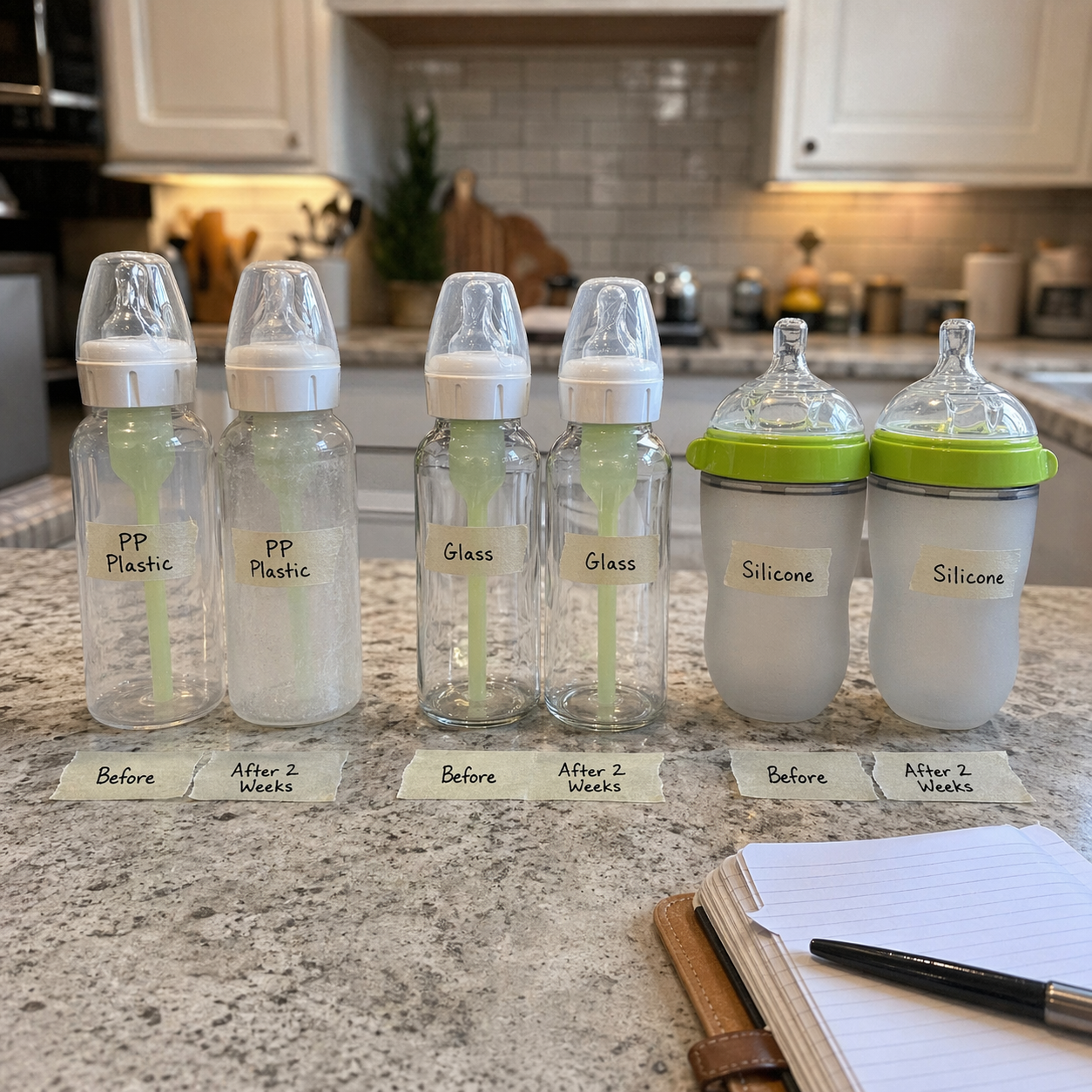
Each setup went through the same daily routine: fill with hot water, shake, let sit, then sterilize. I tracked surface cloudiness, scratches from brush cleaning, and changes after sterilization cycles.
The Verdict: Glass Won. Plastic Lost. Clearly.
Polypropylene plastic bottles: the clear loser. By week two, cloudiness had increased visibly. Fine scratches from bottle brush cleaning were obvious. The interior surface felt rougher to the touch. This isn’t cosmetic, it’s the plastic breaking down. Combined with the research numbers, this is the bottle type you want to move away from, full stop.
Glass bottles: the clear winner. Zero visible change after two weeks of the same routine. Same clarity, same smooth interior surface from day one to day fourteen. Glass doesn’t degrade under heat or agitation the way plastic does. There is no equivalent shedding mechanism. If you can make one change, this is it.
Silicone-lined bottles: a real step up, but not a clean pass. Meaningfully less wear than polypropylene, especially on flat surfaces. But the neck and areas where cleaning tools make contact did show some degradation. Better than plastic, not as safe as glass. A solid transition option if glass isn’t practical right now.
The physical results backed up exactly what the research predicts: heat plus agitation plus repeated cleaning degrades polypropylene. Glass sits outside that equation entirely.

The Question Reddit Parents Were Really Asking
The thread I mentioned wasn’t just asking does this happen. It was asking what do I do now and how bad is it really.
On “how bad is it”: Microplastics have been found in human blood, breast milk, and placental tissue. The long-term health picture isn’t fully mapped yet, but this is not a “we found a trace amount, don’t worry about it” situation. 1.6 million particles a day is not a trace amount. Reducing exposure now is the logical call.
On “what do I do now”: The biggest variables are preparation method and bottle material, and you can change both starting with the next feed.
What Reduces Exposure (Ranked by Impact)
| Action | Why it helps |
|---|---|
| Switch to glass bottles | Eliminates the source entirely |
| Mix formula in glass first, then transfer | Keeps hot liquid out of plastic during the highest-release window |
| Let water cool to ~40°C before adding to plastic | Dramatically reduces particle release vs. boiling water |
| Avoid vigorous shaking in plastic | Agitation + heat is the highest-risk combination |
| Replace scratched or cloudy bottles immediately | Degraded surfaces shed more |
| Skip high-heat sterilization of plastic | Steam sterilizers at 95°C are the worst-case scenario for shedding |
| Use silicone if not switching to glass yet | Better than polypropylene, not as safe as glass |
What I’d Do If Starting Over
- Use glass bottles from day one. Philips Avent, Dr. Brown’s, and Lifefactory all make widely available glass options.
- Mix formula in a glass measuring cup first, then pour into whatever bottle you’re using.
- Skip the microwave entirely. Warm water baths are gentler and more even.
- Don’t high-heat sterilize plastic bottles. You’re accelerating the exact degradation this post is about.
- Replace any bottle that looks scratched, cloudy, or worn. Don’t wait for it to “fall apart.”
And if you used plastic bottles and didn’t know any of this: you weren’t negligent. This information wasn’t being served to parents clearly. The Reddit thread showed that. It wasn’t just one parent who didn’t know, it was hundreds.
If You’re Using Plastics Bottles Now…
If you’re in the early weeks and using plastic bottles: you haven’t locked anything in. The switch to glass is maybe $30 and it’s done. The bigger variables (the heating, the sterilization method, the condition of the bottles) are all adjustable starting with the next feed.
The goal isn’t perfection. It’s reducing the highest-impact exposures where you actually have control.
What’s Your Setup?
Two questions I’m genuinely curious about:
Are you still using plastic bottles, and if so, is switching to glass something you’ve considered or ruled out?
Drop it in the comments. I read every one (even if I dont really get that many lol), and a lot of my future posts come directly from what readers are actually dealing with.
My references
- Microplastic release from the degradation of polypropylene feeding bottles during infant formula preparation, Nature Food
- An Overview of the Possible Exposure of Infants to Microplastics, PMC/NIH
- Microplastics Research, US EPA
- Microplastics release from infant feeding bottles and milk storage bags, ScienceDirect 2024
Written by:
Leave a Reply